-
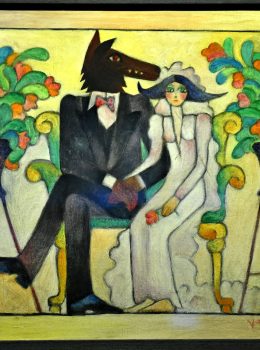
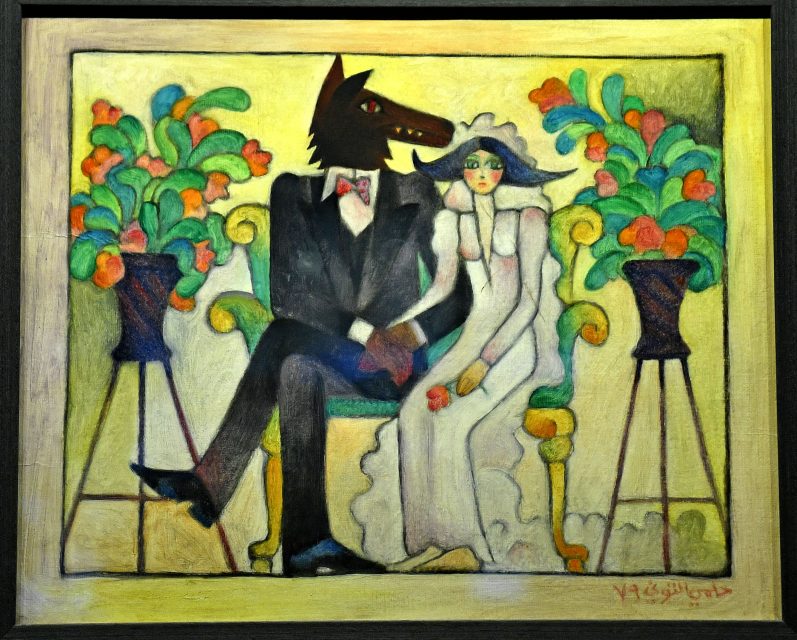
The wedding
1
In 1979, during his years in Beirut, Helmi El-Touni created a rare series of works inspired by Little Red Riding Hood, reimagined not as a childlike tale but as an adult allegory. Drawing on theater, folklore, and symbolic figuration, the artist transforms the familiar narrative into a psychological drama in which innocence, desire, danger, and power coexist. The wolf appears as a cultivated, almost courtly presence—dressed, composed, and seductive—while the female figure oscillates between vulnerability and agency. Through flattened space, bold color, and folk-inflected forms, El-Touni suggests erotic tension without explicitness, using myth as a vehicle to explore intimacy, pursuit, and ambiguity. Created against the backdrop of Beirut’s charged atmosphere in the late 1970s, the series marks an early and daring moment in El-Touni’s practice, where storytelling becomes a means of emotional, cultural, and symbolic inquiry.
-
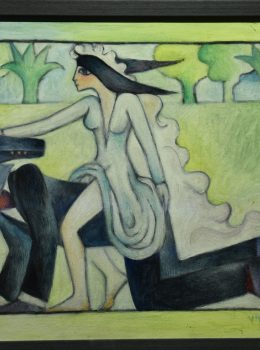
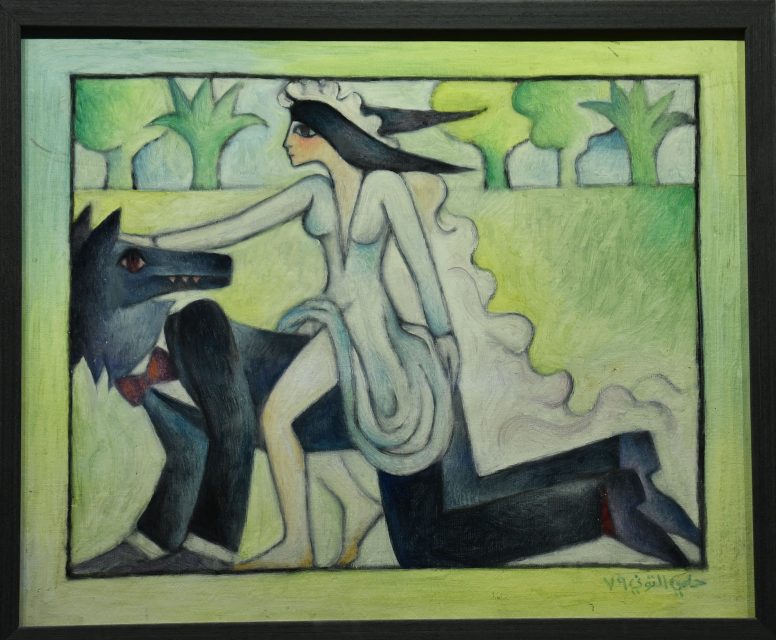
The ride
2
In 1979, during his years in Beirut, Helmi El-Touni created a rare series of works inspired by Little Red Riding Hood, reimagined not as a childlike tale but as an adult allegory. Drawing on theater, folklore, and symbolic figuration, the artist transforms the familiar narrative into a psychological drama in which innocence, desire, danger, and power coexist. The wolf appears as a cultivated, almost courtly presence—dressed, composed, and seductive—while the female figure oscillates between vulnerability and agency. Through flattened space, bold color, and folk-inflected forms, El-Touni suggests erotic tension without explicitness, using myth as a vehicle to explore intimacy, pursuit, and ambiguity. Created against the backdrop of Beirut’s charged atmosphere in the late 1970s, the series marks an early and daring moment in El-Touni’s practice, where storytelling becomes a means of emotional, cultural, and symbolic inquiry.
-
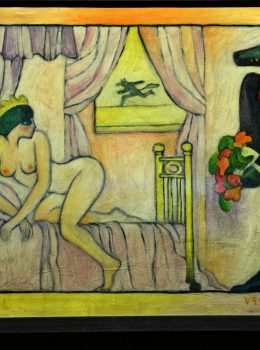
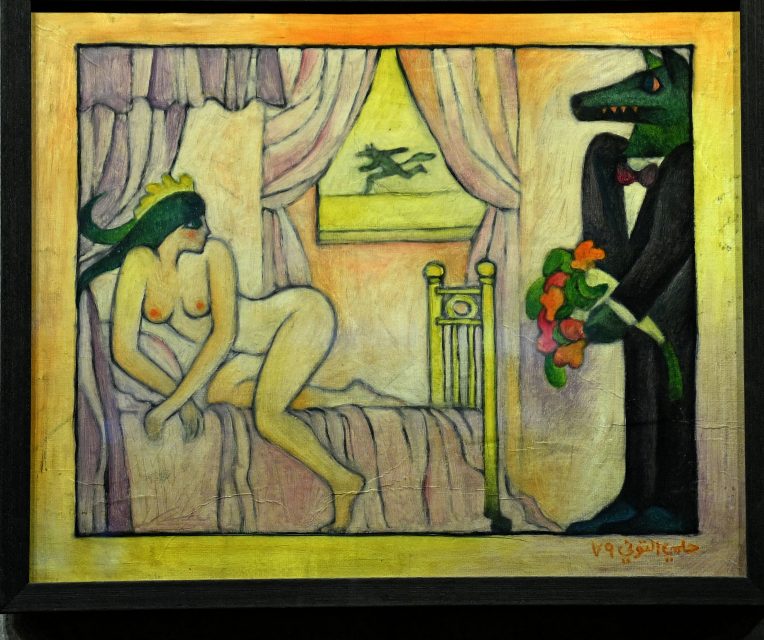
The night
3
In 1979, during his years in Beirut, Helmi El-Touni created a rare series of works inspired by Little Red Riding Hood, reimagined not as a childlike tale but as an adult allegory. Drawing on theater, folklore, and symbolic figuration, the artist transforms the familiar narrative into a psychological drama in which innocence, desire, danger, and power coexist. The wolf appears as a cultivated, almost courtly presence—dressed, composed, and seductive—while the female figure oscillates between vulnerability and agency. Through flattened space, bold color, and folk-inflected forms, El-Touni suggests erotic tension without explicitness, using myth as a vehicle to explore intimacy, pursuit, and ambiguity. Created against the backdrop of Beirut’s charged atmosphere in the late 1970s, the series marks an early and daring moment in El-Touni’s practice, where storytelling becomes a means of emotional, cultural, and symbolic inquiry.
-
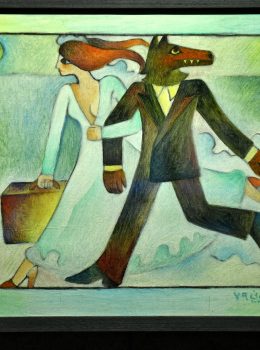
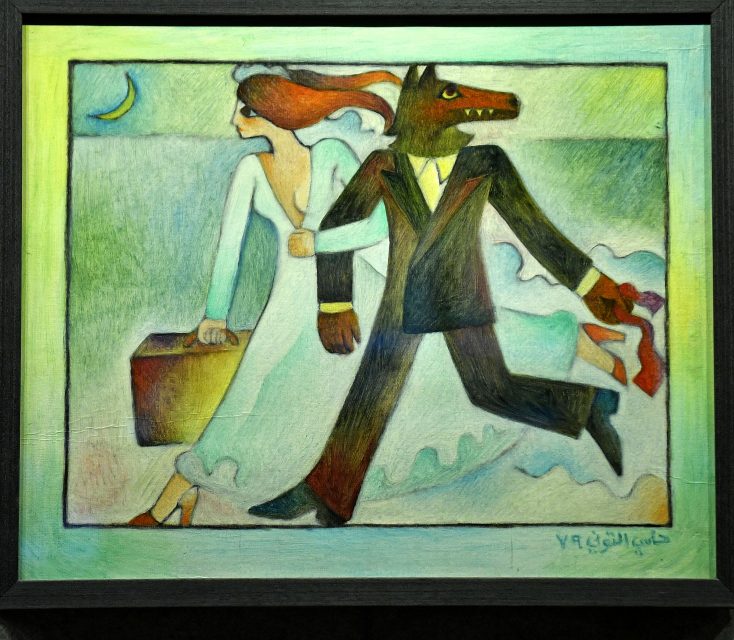
In flight
4
In 1979, during his years in Beirut, Helmi El-Touni created a rare series of works inspired by Little Red Riding Hood, reimagined not as a childlike tale but as an adult allegory. Drawing on theater, folklore, and symbolic figuration, the artist transforms the familiar narrative into a psychological drama in which innocence, desire, danger, and power coexist. The wolf appears as a cultivated, almost courtly presence—dressed, composed, and seductive—while the female figure oscillates between vulnerability and agency. Through flattened space, bold color, and folk-inflected forms, El-Touni suggests erotic tension without explicitness, using myth as a vehicle to explore intimacy, pursuit, and ambiguity. Created against the backdrop of Beirut’s charged atmosphere in the late 1970s, the series marks an early and daring moment in El-Touni’s practice, where storytelling becomes a means of emotional, cultural, and symbolic inquiry.
-
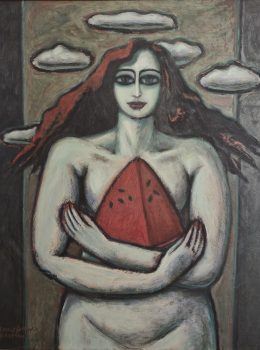
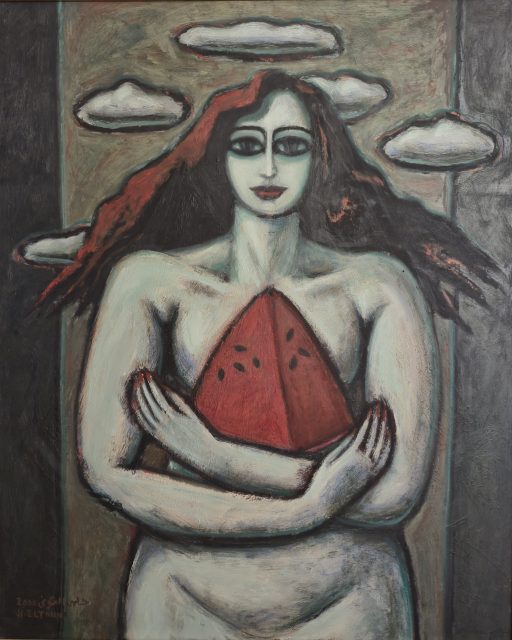
Woman with watermelon
5
A monumental female figure cradles a watermelon shaped like a pyramid, a potent symbol of life, fertility, homeland, and nourishment. The frontal pose, elongated form, and solemn expression recall ancient Egyptian wall paintings and Coptic iconography, transforming the everyday into a timeless, symbolic image of protection and continuity.
-
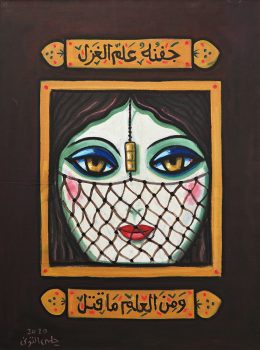
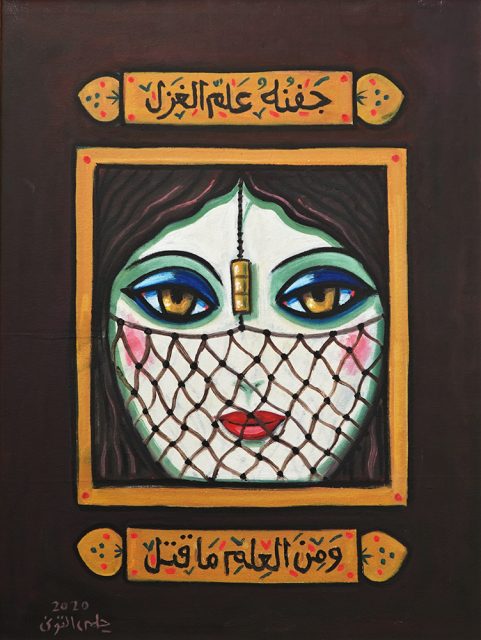
Gafnoho
6
Egyptian artist Helmi Eltouni is well known for his playful visual narratives, symbolic iconography and stylistic outlined figures painted in vibrant colors. Working with themes from Egyptian folklore and heritage, he also addresses current social issues. In “Gafnoho,” he is referencing the song by Abdel Wahab, where he is struck by her beautiful eyes.